
In short
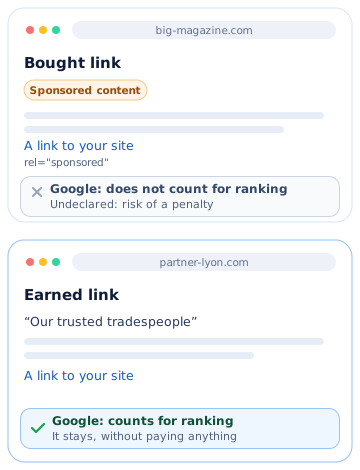
Buying backlinks breaks Google’s rules as soon as the link is meant to lift you in the results. At best, Google ignores the link and you paid for nothing. At worst, a reviewer penalises your site, which drops or disappears from the results. A paid article in a major outlet is no exception: Google asks for its links to be marked as sponsored, and a link marked that way does not count for ranking. I don’t buy links, I don’t sell them, and I don’t promise first place.
What is a backlink?
A backlink, or inbound link, is a link on another site that points to yours. Since its early days, Google has treated it as a recommendation: when a serious site talks about you and links to you, it is a sign that your page deserves to be seen.
That is exactly why a market grew around it. Platforms sell single links, “packs” of dozens of links, or ready-written articles published on blogs or media sites with a link to your site in the middle of the text. For a tradesperson or shop owner starting out, the offer looks logical: pay to be recommended.
Does buying backlinks work?
A batch of bought links sometimes moves a ranking for a while. That is what keeps this market alive. But Google has been tracking these links for a long time. In July 2021 it launched an algorithm update dedicated to link spam, designed to spot and neutralise them, as it explains on its official blog. A neutralised link no longer counts at all: the money is gone.
The real risk comes when the links are numerous or too obvious. A Google reviewer can then apply a manual action: part of the site, or the whole site, drops in the results or no longer appears. For a business that gets its quote requests through its website, that means weeks with far fewer calls.
And those links don’t disappear when you stop paying. Some stay for years on sites you don’t control, and it is your address they point to.
What does Google say about bought links?
Its rules are public, on the page Spam policies for Google web search. The link spam section lists first “buying or selling links for ranking purposes”, and puts in the same category:
- a product or service given in exchange for a link;
- link swaps on a large scale, along the lines of “I link to you, you link to me”;
- advertorials and paid articles containing links meant to improve ranking;
- links in low-quality directories or bookmark sites;
- links created by automated programs, or slipped into forum signatures.
That does not mean Google forbids paying a site to talk about you. It writes that buying links for advertising or sponsorship is a normal part of the web economy, on one condition: the link carries the rel="sponsored" or rel="nofollow" attribute. Its page on outbound links explains this tagging: it flags a paid placement, and Google generally does not follow these links.
The reasoning fits in one sentence. A paid link declared honestly does not lift you, and a paid link that would lift you breaks the rules.
Does a sponsored article in a major outlet help your SEO?
It is the most tempting offer: your business in a well-known magazine, at a price that rises quickly with the title’s fame. On the Google side, it rarely delivers.
The link passes nothing on
A serious outlet marks its paid articles as sponsored, as Google requires, and the link then does not count for your ranking. If it does not, it is a bought link under the rules. Google says it may apply manual actions to sites that publish or obtain links through an excessive number of poorly tagged sponsored articles: the outlet as well as you.
The page no longer benefits from the outlet’s prestige
In 2024, Google added a rule against site reputation abuse: publishing third-party content on a reputable site for the sole purpose of riding on its ranking. In November 2024, it clarified that the host site’s involvement changes nothing, and that it measures separately the sections unrelated to the rest of the site. Since 30 August 2026, in the European Economic Area, these pages no longer receive manual actions, but Google may rank them separately from the rest of the outlet. The paid page no longer benefits from its reputation.
Google does not target advertorials written to be read by the outlet’s audience. It targets those placed there to rank in its results.
The “sponsored” label is mandatory
In France, online advertising must be clearly identifiable as such, under Article 20 of the Law for Confidence in the Digital Economy. The article therefore carries a label such as “sponsored content” or “advertorial”, plainly visible to readers.
A paid article still has one use: being read by the outlet’s audience, if that audience is yours. A bakery in Lyon’s Croix-Rousse district has little to gain from an article in a national business magazine. An article in its neighbourhood press, written because it has a story to tell, will do more for it.
What is black hat SEO?
Black hat SEO covers techniques that try to fool Google rather than serve the reader. Buying links is one of them. Here are the other practices Google names in its rules, which still turn up in quotes or on existing sites:
| Practice | What it is |
|---|---|
| Keyword stuffing | Repeating “plumber Lyon” twenty times on a page, or lining up lists of towns with no sentence around them. |
| Hidden text or links | White text on a white background, or text hidden behind an image: Google reads it, the visitor does not see it. |
| Cloaking | Showing Google a different page from the one the visitor sees. |
| Doorway pages | Dozens of near-identical pages where only the town name changes. |
| Scaled content | Hundreds of pages generated automatically, for example with AI, adding nothing for the reader. |
| Site network | Blogs created only to link to the websites of a provider’s clients. |
| Expired domain abuse | Buying the address of a closed school or association to exploit its former reputation. |
| Fake reviews | Buying reviews or writing them yourself. The Google reviews guide details what is forbidden. |
These techniques sometimes work for a while. Then a Google update rolls out and the site drops overnight. The provider was paid long ago.
How can you tell if Google has penalised your site?
Open your site’s Search Console, then the “Security & Manual Actions” menu, “Manual actions” section. If a Google reviewer has penalised the site, it is written there, with the reason and the pages affected. Google also notifies you with a message in Search Console. Its help page on the Manual actions report explains how to read it.
Without a message, a drop can have many other causes: a Google update, a competitor moving up, a changed page, a technical issue. A sudden fall right after a bought-link campaign is still a serious clue.
An agency bought links for your site: what should you do?
First, look at who links to you. In Search Console, the Links report lists the sites that point to yours. Dozens of blogs unrelated to your trade, foreign-language sites or articles all built on the same template are a bad sign. If you pay for a link subscription, cancel it.
Then, don’t panic. On its page about disavowing links, Google explains that it can sort links out in most cases and that the tool is of no use to most sites. It reserves it for sites receiving a considerable number of artificial links that have caused, or may cause, a manual action. In that case, first ask the sites publishing the links to remove them, then disavow the ones that remain. Used badly, the tool can also cancel out links that were helping you: better keep it for that specific case.
Getting links without buying them: what I do instead
I don’t buy links for my clients, I don’t sell them as an option, and I haven’t bought any for orbitoile.fr. Nor do I promise first place on Google. Google says so itself in its advice on hiring an SEO: “No one can guarantee a #1 ranking on Google.” A quote that promises it should ring alarm bells.
My work focuses on what you control:
- a site that is fast on a phone and says clearly what you do and where you work;
- pages that answer the questions your customers actually type into Google, like this one;
- a complete Google Business Profile and a few serious directories, in the week after launch;
- links that come on their own: a supplier, an association, a business client, the local press. The local SEO in Lyon guide explains where to find them.
It is slower than a pack of a hundred links. But none of it can turn against you at Google’s next update.
Key takeaway
Buying backlinks to climb on Google breaks its rules: the link is neutralised, or it earns the site a penalty. A sponsored article in a major outlet must be declared as such, and its link then does not count for ranking. A fast site, useful pages and earned links take longer, with no risk at all.