
In short
A website for tradespeople must turn a search made on a phone into a call or a quote request. At Orbitoile, it is based on the showcase site package: up to 5 pages, a call button and a quote request on every page, your job site photos and your service area. During the launch period it starts at €590 and it goes live 2 weeks after I receive your texts and photos.
What a website for tradespeople includes
A website for tradespeople follows the showcase site package, built for a trade where the customer looks for a professional near home and wants to reach them quickly.
| Item | What is planned |
|---|---|
| Pages | Up to 5 pages: home, services, projects, area and contact, legal notice |
| Contact | Clickable phone number and a “Ask for a quote” button on every page |
| Design | Mockup approved before coding, phone-friendly site, headings and markup for Google, Search Console |
| Visibility | Google Business profile and directory listings created or completed within the week following launch |
| Hosting | No monthly fees, with a domain name in your company’s name, about €15 per year |
| Timeline | 2 weeks from receipt of your texts and photos |
You provide your photos and your information: services, towns, opening hours. Changes after launch are made on request, with a quote, with no subscription.
The legal notice is one of the 5 pages. For a craft business, it states in particular your registration number in the RNE (the French business register), as detailed in the Service-Public page on mandatory information.
The five needs of a website for tradespeople
A customer looking for a tradesperson reads very little. They want to know five things, roughly in this order, and the site must answer without making them search.
| The customer wants | What the site shows them |
|---|---|
| To know if you come to their area | Your trade and your areas from the first line: “Plumber in Lyon 3rd, 7th and Villeurbanne” |
| To reach you right away | A clickable number at the top of every page, and a call button that stays visible on a phone |
| To see your work | Photos of your job sites, with the type of work and the town |
| To feel reassured | Your Google reviews, the qualifications and insurance you really hold, your SIRET number |
| To ask for a price | An “Ask for a quote” button that prepares the message for them |
One page per main service also helps Google: “emergency repair”, “bathroom” and “water heater” are three different searches. The showcase site guide explains the role of each page.
The quote request: how it reaches you
On every website for tradespeople that I build, custom-coded, the “Ask for a quote” button opens a ready-made e-mail in the customer’s mail app, with the useful questions: town, type of work, desired timeline. They complete it, add a photo if they want, and send it. You receive the request like any ordinary e-mail, on your phone.
This system has one advantage: there is no form to host and no data stored on the site. Its limit: the customer must have a mail app on their device, which is the case on most phones. That is why the phone number always stays visible next to it.
If you prefer a real form, with automatic sending and an acknowledgement of receipt, an external sending service is needed, to be planned in the quote. In both cases, you inform the customer of how their contact details are used, as the CNIL (the French data protection authority) requires.
Job site photos in a website for tradespeople
Photos do more for a tradesperson than any text. The ones from your phone are enough, if they are sharp and taken in daylight.
- a before and an after taken from the same spot, when possible;
- a short caption for each: type of work, town, duration of the job;
- only your own job sites: a stock photo passed off as your work is easy to spot and costs you trust;
- the customer’s agreement before publishing a photo taken at their home, with no address or recognisable face.
I crop and slim down every photo before launch: a phone photo often weighs several megabytes, and a gallery that is too heavy slows the site down just when the customer opens it. For reviews, the Google reviews guide gives a template message to send after a job.
The service area in Lyon and the metropolitan area
On a website for tradespeople, list the districts and towns where you really work. A customer in Saint-Priest who reads that you work between Lyon 6th and Caluire-et-Cuire knows right away whether to call you, and saves you a pointless trip.
On your Google profile, declare the same area as a “service area”: your address does not need to be displayed if you work at your customers’ premises. Google notes that complete and accurate profiles are more likely to appear in local results (Google help). The details are in the local SEO in Lyon guide.
One page per area is only useful if you have something of your own to say there, such as jobs completed locally. Identical pages where only the town name changes hurt the site instead of helping it.
Example: the home page of a plumber in Lyon
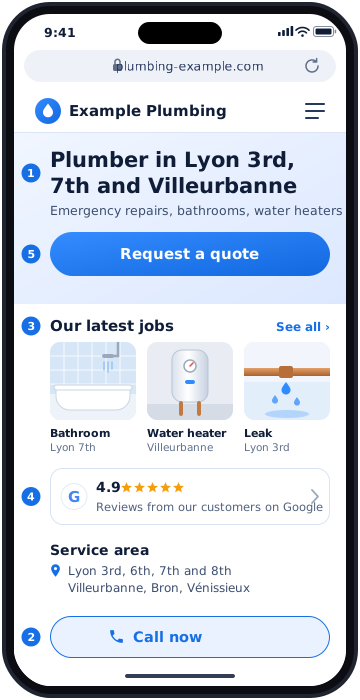
Here is the structure I suggest for the home page of a website for tradespeople, as it appears on a phone. The company is fictional: it is an example mockup, not a client.
Real example
The site I built for Sentinelle Investigations, a private detective agency in Lyon, applies the same principles to another trade: pages by geographic area, FAQ, one-tap calling on mobile. Measured on 24 October 2026 with PageSpeed Insights, it scores 99/100 on mobile.
What the site will not do for you
Even well built, a website for tradespeople does not do everything:
- it does not replace your Google profile: it is often the profile that triggers the first call, and the site that confirms it;
- it will not put you at the top of searches far from where you work: distance counts in local results;
- it does not fill itself: without photos or recent reviews, it reassures less.
For the cost over several years, see the website creation cost guide. If your customers book a slot or buy online, look instead at the website with online booking or the online shop.
Key takeaway
An effective website for tradespeople states your trade and your area from the first line, lets people call or ask for a quote from every page, and shows your real job sites and your reviews. At Orbitoile, it starts at €590 and goes live in 2 weeks.