
In short
With website rental, you pay a rent every month for several years instead of paying for the site once. The contract is often transferred to a leasing company, which demands the rent until the end of the term, even if the provider no longer answers. In France, if you employ five people or fewer and signed at your own premises, you usually have 14 days to withdraw.
How does website rental work?
A provider builds your site, puts it online and bills you through a monthly rent, over a period set in the contract. The rent often covers hosting, maintenance and sometimes a few changes. The site is not sold to you: you can use it as long as you pay.
In many contracts, a third party appears: a financial leasing company, also called the lessor. The provider transfers the contract to it right after signing. The lessor collects your rent, while the provider remains the one who built the site. This three-party setup explains most of the difficulties described below.
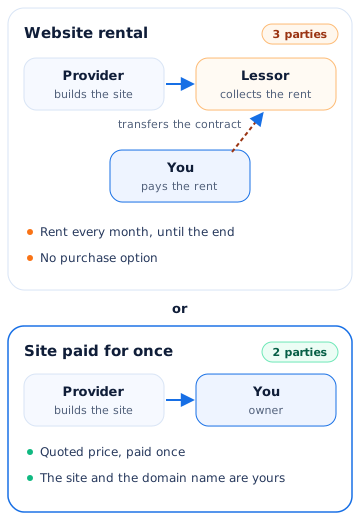
Adding up the total of a website rental contract
The figure that matters is the total, not the rent. Do the maths before signing:
- multiply the monthly rent by the number of months in the contract: over 48 months, every euro of monthly rent costs €48;
- add any set-up or administration fees;
- look at what happens at the end: renewal, a new contract, or the site goes offline;
- check whether the domain name and the content remain yours at the end.
Then compare this total with a site paid for once, adding the costs that come back every year, such as the domain name and, depending on the technology, hosting. The DGCCRF notes that at the end of a financial leasing contract, the cost of the rented item can turn out to be prohibitive. The guide website pricing details the items in a quote and the yearly costs to plan for.
Provider and lessor: who answers when the site has a problem?
In an investigation published in 2022, the DGCCRF examined the door-to-door sales practices of website providers and web agencies offering rental contracts. Its page financial leasing for canvassed professionals (in French) describes what it found:
- a single visit from the salesperson, meant to end with a signature;
- a contract sometimes reduced to an order form filled in by the seller, where the monthly rent appears discreetly;
- clauses that make the supply contract and the leasing contract independent of each other;
- a lessor that is not responsible for delivering the service, and that is paid through the rent whatever the difficulties;
- delivery of the site rarely recorded in a document confirming it matches what was ordered.
In practice: if the site does not work or the provider no longer answers, the lessor keeps claiming the rent. The DGCCRF states that it generally demands that the contract be honoured until the end of the term, and does not hesitate to take the tenant to court for unpaid rent. It adds that this kind of leasing, unlike lease-purchase, includes no purchase option and is not subject to any specific regulation.
Signed at your premises: the 14-day period for small businesses
Under French law, a business does not in principle have the same protection as a consumer. Article L. 221-3 of the French Consumer Code makes an exception, explained by the DGCCRF in its sheet small businesses: you have 14 days to withdraw (in French). Three conditions must all be met:
- you employ five people or fewer;
- the contract was signed off-premises, for example in your shop, your workshop or your home, after a salesperson’s visit;
- the purpose of the contract falls outside your main business: the DGCCRF refers to small businesses buying goods or a service outside their core activity.
You can then withdraw within 14 days of signing the contract, without giving a reason. Send the withdrawal form attached to the contract by registered letter with acknowledgement of receipt; if there is no form, any unambiguous statement is enough. If the contract did not inform you of this right, the period is extended by twelve months. The law does not require any payment before seven days from signing, even if the seller asks for it, with exceptions set out in article L. 221-10.
This period does not apply to contracts signed online, by phone, or at a fair or trade show. The contract must also contain, among other things, the price, the termination terms and a withdrawal form: according to the DGCCRF, a contract that does not give all the mandatory information may be declared void.
Termination and end of a website rental contract
Once the withdrawal period has passed, or if the conditions are not met, the contract decides. Before signing, look in the terms and conditions for:
- the exact length and end date;
- whether you can terminate before the end, and what it costs: in the contracts described by the DGCCRF, the lessor demands the rent until the end;
- renewal at the end, automatic or not, and the notice period;
- what happens to the site at the end: with no purchase option, there is often nothing to buy back, and the site stops with the contract.
If a clause seems unclear, ask for a written answer before signing, and keep it with the contract.
Ownership of the site and the domain name
Two separate questions to ask: who owns the site, and in whose name is the domain name registered?
The domain name is your site’s address. It is registered in the name of a holder, with a registrar. For a .fr address, the Service-Public page registering a website’s domain name (in French) explains how to check the Afnic registry with the Whois service. If the holder is the provider, the address your customers know may leave with them at the end of the contract.
For the site itself, ask whether you will be able to recover the texts, photos and files at the end, and in what form. At Orbitoile, the site you pay for belongs to you, and the domain name is registered in your company’s name.
Questions to ask before signing
The DGCCRF advises not to sign anything in a hurry, to take time to study the documents and to find out about the company presenting them. These questions help:
- What is the total amount paid over the whole term, fees included?
- Will the contract be transferred to a leasing company? Which one?
- Who do I contact if the site breaks down or if I want to change a page?
- Can I terminate before the end, and how much does it cost?
- What happens to the site and the domain name at the end of the contract?
- Where in the contract are the information on the right of withdrawal and the form?
An evasive answer to any of these questions is a good reason to ask for other quotes.
Rent or buy: comparing the two options
| Point to check | Rental with a lessor | Site paid once (Orbitoile) |
|---|---|---|
| Payment | A rent every month, until the end of the term | The quoted price, paid once, from €590 for a showcase site |
| Yearly costs | Included in the rent, depending on the contract | The domain name, about €15, re-invoiced at cost |
| Ownership | No purchase option, according to the DGCCRF | The site and the domain name are yours |
| Contact | The lessor for the rent, the provider for the site | One person, Alexandre Mizzi, in Lyon |
| Changes | As set out in the contract | On request, on a quote, with no subscription |
Rental can suit someone who wants no upfront outlay and accepts paying more in total. It then requires reading the whole contract, especially the pages on the lessor and on termination.
If something goes wrong with your contract
- Write to the provider and the lessor by registered letter, quoting the contract and the dates.
- If you employ five people or fewer and the contract was signed off-premises, you can file a report on SignalConso, as the DGCCRF reminds: attach proof of your headcount, describe how the contract was signed and name all the parties, including the seller and the financing company.
- If the dispute continues, you can contact a conciliator of justice, then, as a last resort, the competent court.
This guide is for information and does not replace legal advice. For a contract already signed, have it reviewed before stopping any payment.
Key takeaway
Website rental should be judged on its total cost and its exit terms, not on its monthly rent. Check whether the contract will be transferred to a lessor, who keeps the site and the domain name, and how to terminate. Signed at your premises with five employees or fewer: in France, you usually have 14 days to withdraw.