
In short
A restaurant website shows your menu with its prices, your up-to-date hours and a way to book, all readable on a phone. At Orbitoile, it starts at €590 during the launch period, live 2 weeks after receipt of your menu and photos. If booking or takeaway happen directly on the site, the package changes: the table below helps you choose.
What a restaurant website includes
A restaurant website follows the showcase site package, built around what a customer looks for before walking in: the menu, the hours and the address.
| Item | What is planned |
|---|---|
| Pages | Up to 5 pages: home, menu, the place and the team, practical information and contact, legal notice |
| Menu | A real page, readable on a phone, with prices, the origin of meats and access to allergens |
| Contact | Clickable number, directions button and link to your booking tool on every page |
| Visibility | Google profile and directory listings created or completed within the week following launch, menu and hours matching the site |
| Hosting | No monthly fees, with a domain name in the name of your business, about €15 per year |
| Timeline | 2 weeks from receipt of your menu, your texts and your photos |
You provide your menu, your hours and your photos. Menu changes after launch are made on request, on quote, with no subscription: if your menu changes every week, we talk about it from the first conversation to plan the simplest solution.
The five questions of a hungry customer
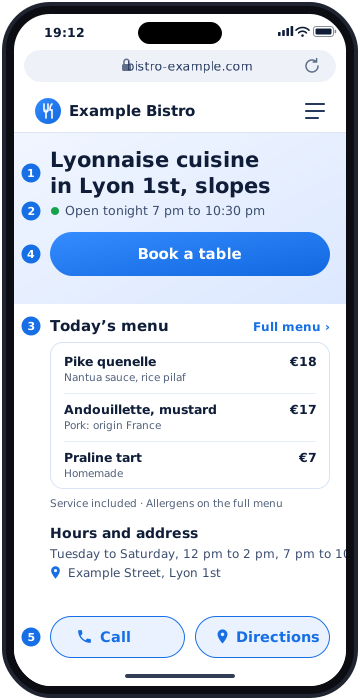
A customer looking for a restaurant reads very little. They want five answers, roughly in this order, and a good restaurant website gives them without making them search.
| The customer wonders | What the site shows them |
|---|---|
| What kind of food, and where? | Your cuisine and your neighbourhood from the first line: “Lyonnaise cuisine, Lyon 1st” |
| Are you open now? | Today’s hours at the top of the home page, and exceptional closures announced |
| What is there to eat, and at what price? | The full menu, with prices, one tap away |
| Can I book? | A “Book a table” button visible without scrolling |
| How do I get there or reach you? | A call button and a directions button, which stay visible on a phone |
Photos come right after: a few dishes and the dining room, taken by you in daylight, are enough. Stock photos, on the other hand, disappoint the customer once seated.
The menu as a real page rather than a PDF
Many restaurants put their menu online as a PDF or a photo. On a phone, you then have to zoom, drag the image and wait for it to load. In a well-built restaurant website, the menu is a page like any other, with three advantages:
- it reads without zooming, with dishes sorted into starters, mains and desserts;
- Google can read its content: “pike quenelle Lyon 1st” becomes a search your site can answer, which a photo of a menu does not allow;
- it stays light: a text page displays much faster than a PDF of several megabytes on a mobile connection.
Keep a single reference version. A menu that is up to date on the site but out of date on your Google profile, or the reverse, causes disappointment at the table: I carry the same dishes and the same prices over to both places.
What the law requires you to display, and what the site must carry over
A restaurant has precise display obligations. The Service-Public page on the regulation of bars and restaurants, checked by the administration on 18 February 2025, brings them together. The main ones that concern your menu:
- the price of all dishes and drinks, with the mention “service included” when service is included;
- the country of origin of beef, pork, lamb and poultry, for all dishes containing them;
- information on the allergens in dishes, on the menu or in a document kept available to customers;
- the possibility of asking for tap water free of charge;
- the “homemade” mention or logo, only for dishes that meet the conditions set out.
According to the same page, the obligation on the origin of meats also applies to takeaway, delivery and any communication aimed at customers. Your site’s menu must therefore state this origin, like your paper menu. For allergens, two simple solutions: a note under each dish, or an allergen table on the menu page.
These rules do not replace the advice of your professional organisation or your accountant for your specific case. The site’s own notices, who publishes it and who hosts it, are detailed in the guide legal notices of a website.
Which restaurant website package for your service
The right site depends on how your customers book and order. The prices below are Orbitoile’s launch rates.
| Your situation | The right solution |
|---|---|
| Customers book by phone, or with a booking tool you already have | The showcase site, from €590, in 2 weeks: call button and link to your tool |
| You want table booking to happen on your own site | The site with online booking, from €890, in 3 weeks, set up for your services and covers |
| You sell takeaway with online payment | The online shop, from €1,190, in 4 weeks, with pick-up at the chosen time |
| You already use a delivery platform | The showcase site is often enough: it presents your restaurant and links to the platform |
All amounts are VAT not applicable, art. 293 B of the French General Tax Code. The number of pages and features is set in the quote.
Table booking: how it works
Three ways to receive bookings, which can be combined:
- The phone, with a clickable number on every page. It is the simplest, and many customers prefer it for a table the same evening.
- Your booking tool, if you already use one: the site’s button opens your booking page, and your slots stay managed in the same place.
- The Google profile, which can offer a booking button linked to a compatible tool. The Google help also describes adding a detailed menu, photos and online ordering to a restaurant’s profile.
If your tool sends confirmation or reminder SMS, these messages serve the booking. Sending promotional offers by SMS or e-mail afterwards follows other rules: the customer must have agreed, with some exceptions, and each message must allow a simple unsubscribe. The CNIL details these conditions.
Being found in your Lyon neighbourhood
Restaurant searches are very local: “bouchon Vieux Lyon”, “brunch Croix-Rousse”, “restaurant near Part-Dieu”. A restaurant website in Lyon names your neighbourhood, your nearby landmarks and your type of cuisine with the words your customers use, without repeating the names of ten districts where you are not.
The Google profile does the rest: exact category, hours, public holiday hours, recent photos and a link to your site. The guide local SEO in Lyon details each setting, and the guide Google reviews explains how to get them and reply to them, which matters a lot in catering.
Example: the home page of a bistro in Lyon
Here is the structure I propose for the home page of a restaurant website, as it displays on a phone. The bistro is fictional: it is an example mockup, not a customer.
Real example
The site I built for Sentinelle Investigations, a private detective agency in Lyon, applies the same principles to another trade: useful information first, one-tap calling on mobile, light pages. Measured on 24 October 2026 with PageSpeed Insights, it scores 99/100 on mobile.
Limits of a restaurant website to know about
- on a custom-coded site, changing the menu goes through me, on quote: for a slate that changes every day, we rather plan a dish of the day announced on the Google profile and on social media;
- the site does not fill the dining room on its own: the Google profile, reviews and word of mouth remain the first triggers;
- delivery platforms keep their own rules and commissions: the site presents your restaurant, it does not necessarily replace them.
To compare the cost over several years, see the guide price of building a website.
Key takeaway
An effective restaurant website states your cuisine and your neighbourhood from the first line, shows a readable menu with prices and the origin of meats, and lets people book, call or come in one tap. At Orbitoile, it starts at €590 and goes live in 2 weeks.