
In short
A website for a liberal profession shows your title, your areas of practice, your fees and a simple way to reach you, without promising anything your profession forbids. At Orbitoile, it starts at €590, online 2 weeks after I receive your texts. If you practise a regulated profession, the notices required by your professional body are planned from the start.
What a website for a liberal profession includes
A website for a liberal profession builds on the showcase site package, organised around what a person checks before entrusting you with a matter: your title, the way you work and your terms.
| Item | What is included |
|---|---|
| Pages | Up to 5 pages: home, areas of practice, your background, fees and contact, legal notices |
| Title | Your exact professional title and, for a regulated profession, the professional body you belong to |
| Contact | Tap-to-call number, practice address with directions, a short form that only asks for what is useful |
| Visibility | Google profile created or completed in the week after going live, following the rules for professionals |
| Cookies | No cookies set, so no consent banner |
| Timeframe | 2 weeks from receipt of your texts and photos |
You provide your texts, or the material for me to write them with you, and a photo of yourself or the practice. The domain name is in your name, about €15 a year, with no monthly subscription.
Regulated profession or not: what changes for your site
Not all liberal professions follow the same rules. The Service-Public page on regulated and non-regulated liberal professions, checked by the French administration on 20 January 2025, distinguishes them as follows:
| Your case | What it means for your site |
|---|---|
| Regulated liberal profession | Protected title, rules set by law and a code of ethics enforced by a professional order, chamber or union. The site shows this title and follows your body’s communication rules. |
| Non-regulated liberal profession | Consultant, trainer, copywriter, sophrologist, for example. No professional order: the site follows the rules for any business, with more freedom in the presentation. |
The same page states that there is no official list of non-regulated liberal professions. If you are unsure about your situation, your order, chamber or professional body remains the right reference: I build the site from what it tells you.
Notices specific to regulated professions
Like any professional site, yours states who publishes it and who hosts it. The Service-Public page on the mandatory notices of a business website, checked on 13 October 2026, adds for a regulated profession:
- your professional title;
- the professional rules that apply to you;
- the European Union member state where this title was granted to you;
- the name of the order or professional body you are registered with.
I place this information in the legal notices, and I repeat your title at the top of the home page, where visitors look for it. For the other notices, which apply to every business, see the guide legal notices of a website.
What your professional body regulates, and how the site adapts
Each order or professional body sets its own communication rules. They differ from one profession to another, and I do not guess them: before writing, I ask you for the text that applies to you, or I read it with you.
In practice, a good website for a liberal profession rests on a few simple principles, which you approve page by page:
- facts rather than promises: your training, your areas, how you work, without announcing results;
- no fake reviews and no rewritten testimonials;
- real photos of the practice and of you, rather than stock images that ring false;
- the vocabulary of your profession explained in plain words, for a visitor discovering their situation.
You have the final say on every sentence: it is your name, and your professional responsibility, that appear on the site.
Are you a lawyer? The domain name, notifying the bar and secrecy over client names are covered on the page lawyer website.
Showing your fees on a liberal profession website
Without any indication of price, visitors have to call you to find out whether you fit their budget. Three ways to present your fees, depending on your profession:
- A price list for routine services, with a price for each.
- An hourly rate or a starting flat fee, with what it includes and what makes it vary.
- The calculation method, when every case is different, with the point at which you provide a quote or a fee agreement.
If you work with private individuals, the Service-Public page on mandatory notices indicates, for the terms of sale aimed at them, a price in euros including all taxes. For business clients, the price can be given excluding tax. Your professional body may have other rules on fees: they take precedence over this model.
The contact form and confidentiality
In a first message, some people describe their whole situation. The form should stay short: name, a way to reply, one sentence on the purpose of the request. The details come later, at the appointment or through a channel you choose.
The CNIL, the French data protection authority, gives sample forms. It asks you to inform people at the time of collection: who is responsible for the data and how to contact them, what it is used for, on what legal basis, who receives it, how long it is kept, and which rights the person can exercise. It also advises distinguishing mandatory fields from the others, for example with an asterisk.
The site itself sets no cookies, which avoids the consent banner. The guide cookie-free website explains why this is possible and what it changes.
Your Google profile as a professional
Google has specific rules for professionals who see their own clients. Its guidelines for representing your business provide in particular:
- a profile in your name if you deal directly with clients and can be reached at the stated address during the listed hours;
- not one profile per specialty: a single profile represents you;
- in a practice with several professionals, a profile for the practice, separate from the professionals’ profiles, whose titles contain only their own names.
The site and the profile must say the same thing: same name, same address, same hours. I link the two, and the guide local SEO in Lyon details the other settings that matter near you.
Which website for a liberal profession to choose
The right site depends on how your clients book. The rates below are Orbitoile’s net prices.
| Your situation | The right solution |
|---|---|
| People call or write to you for a first conversation | The showcase site, from €590, in 2 weeks: tap-to-call number and short form |
| You already use an online calendar | The showcase site is enough: the site’s button opens your calendar, and your slots stay managed in one place |
| You want appointments to be booked on your own site | The website with online booking, from €890, in 3 weeks, set to your hours and appointment types |
All amounts are VAT not applicable, art. 293 B of the French General Tax Code. The number of pages and features is set in the quote.
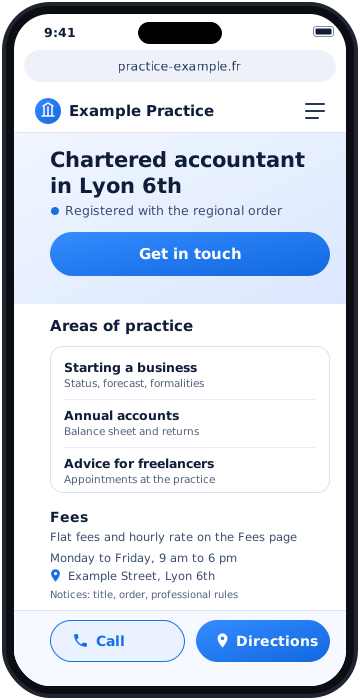
Example: the home page of a practice in Lyon
Here is the structure I suggest for the home page of a website for a liberal profession, as it appears on a phone. The practice is fictional: it is a sample mock-up, not a client.
Real example
The site I built for Sentinelle Investigations, a private detective agency in Lyon, meets the same needs: a regulated activity, clients who want discretion, useful information first and light pages. Measured on 24 October 2026 with PageSpeed Insights, it scores 99/100 on mobile.
Limits of a website for a liberal profession to know about
- I am neither a lawyer nor a member of your professional body: I point out what to check, but compliance with your profession’s rules remains your decision;
- the site is not a tool for exchanging confidential documents: to send files, keep the tool your profession recommends;
- on a custom-coded site, changing a text after going live goes through me, on quotation, with no subscription.
To compare the cost over several years, see the guide price of building a website.
Key points
An effective website for a liberal profession shows your title from the first line, presents your fees clearly, asks for as little information as possible in its form and follows your professional body’s communication rules. At Orbitoile, it starts at €590 and goes live in 2 weeks.